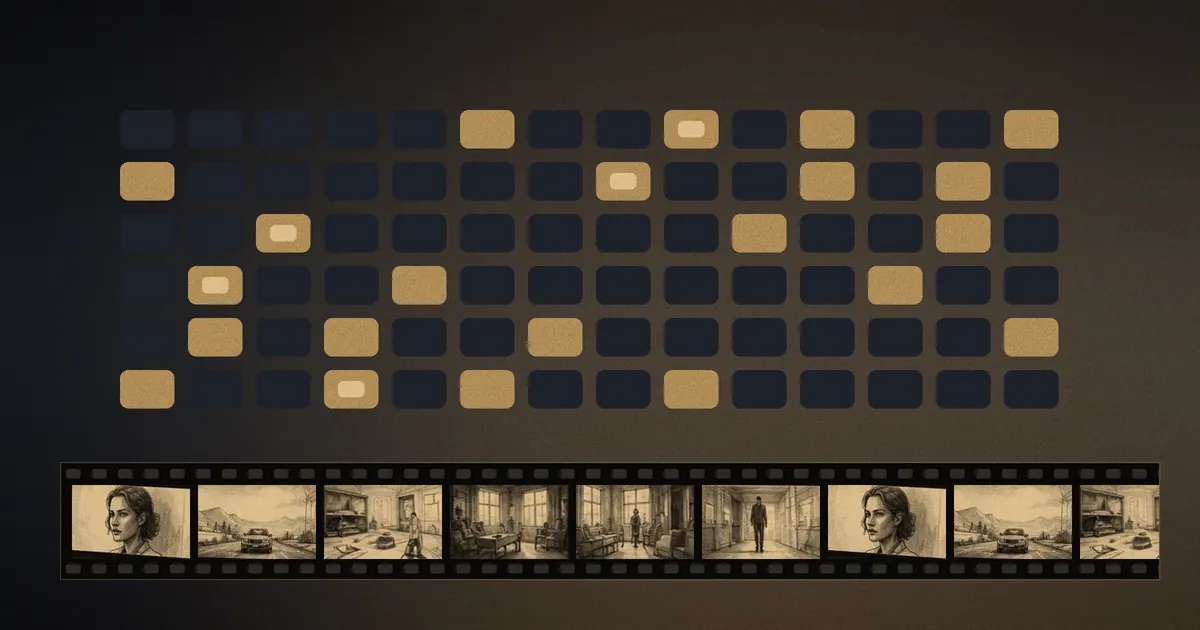
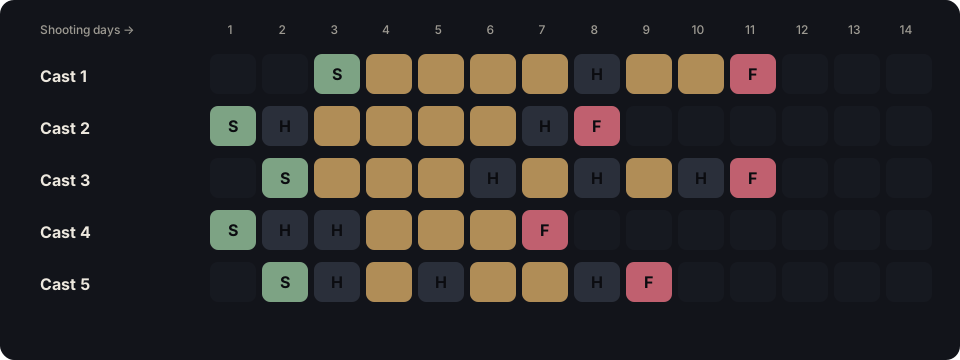
A day out of days report, usually shortened to DOOD, is a grid that shows, for every cast member or other tracked element, which shooting days they are working, which days they are on hold and when they start and finish. Rows are cast members, columns are shooting days, and each cell holds a status code. Producers and assistant directors use it to price actor deals, avoid paying for idle days and see at a glance who is needed when.
What a DOOD report shows
The report answers three practical questions. On which day does each actor first arrive? On which days are they needed? When are they released? Everything else, from contracts to catering counts, follows from those answers.
It is built from the shooting schedule, not from the screenplay directly. The schedule (the stripboard) already assigns every scene to a day, and the cast list of each scene says who is in it. Put the two together and the grid follows. This is why a DOOD is a derived document: if the schedule changes, the report must change with it.
DOODs can also track elements other than cast, such as key props, vehicles, animals or special equipment. Cast is the most common use, and what follows concentrates on it.
The status codes
The codes below are the most widely used, but codes vary by production, by software and by country, so always read the legend printed on the report you are given.
| Code | Meaning | Typical use |
|---|---|---|
| SW | Start work | First working day for that person |
| W | Work | A working day in the middle of the engagement |
| WF | Work finish | Last working day |
| SWF | Start, work, finish | A one-day engagement |
| H | Hold | Paid day off between working days; the actor must stay available |
| (blank) | Not required | The actor is free and not paid for the day |
Some productions add codes for travel (T), rehearsal (R), wardrobe fittings, screen tests or drop days. Others use only S, W, H and F. Treat the legend as part of the document.
Why producers and ADs care
Deal pricing. Many actor deals are priced per day or per week, and a start-to-finish span matters. A week-long deal for an actor who works two days spread over nine is expensive. The DOOD shows the span and the gaps at once.
Holds. Between working days an actor often stays on hold, which means unavailable to other productions and, under many contracts, still paid. Holds are a cost line, and a DOOD makes them visible so they can be reduced.
Overlap. If two key actors have only a few shared days, the shooting order may be arranged around them. A DOOD makes such pressure points obvious before they become expensive.
Logistics. Wardrobe fittings, travel, accommodation, makeup call times and meal counts all depend on who is on set. Department heads read the report to plan their own work, which links back to the script breakdown that started the chain.
How to build one by hand
For a small shoot the report can be built in a spreadsheet in an hour. Work from a locked or at least stable schedule.
- List the shooting days in order and number them: Day 1, Day 2 and so on. Add the date if you have it.
- List the cast with their character numbers, using the order on the cast list from the breakdown.
- For each day, list the scenes the schedule assigns to it, and note the cast in those scenes.
- Mark W in every cell where the actor appears in a scene that day.
- Find each actor's first and last working day. Mark the first SW, the last WF, and a single working day SWF.
- Fill the gaps. Days between the start and the finish when the actor is not working become H, unless the actor is released for the gap, in which case leave them blank or note the drop and pickup.
- Count the working days, hold days and total span for each actor, and put the totals at the right.
Example
This is an invented example for a five-day shoot.
| Cast | D1 | D2 | D3 | D4 | D5 | Work | Hold |
|---|---|---|---|---|---|---|---|
| 1. Mara (lead) | SW | W | W | W | WF | 5 | 0 |
| 2. Jonas | SW | W | H | W | WF | 4 | 1 |
| 3. Dr. Lund | SWF | 1 | 0 | ||||
| 4. Ivy | SW | H | H | WF | 2 | 2 |
Ivy is the one to look at. She works only two days, but her span is four. Two hold days are a cost, and a producer would ask whether the schedule can move her scenes closer together or whether she can be released between Day 2 and Day 5 and picked up again. Jonas has one hold day, which the schedule might also absorb. Dr. Lund, a single-day role, is simple and cheap.
Common pitfalls
- Reordering days without updating the report. The most common error. Any change to the stripboard changes the DOOD, so rebuild it whenever the schedule moves, and date each version.
- Forgetting that a scene can include several actors. One missing name makes the report wrong, and the actor can be told the wrong day.
- Counting holds as free. Holds usually cost money. Check the contract.
- Mixing codes. Using SW on Monday and S on Tuesday confuses everyone. Pick one convention and print a legend.
- Ignoring travel and rest. An actor flown in the day before needs a travel day, and some contracts require rest between a night shoot and a morning call.
- Treating the report as final. Weather, availability and location changes alter schedules. A DOOD is accurate only as of its version date.
Tools can do the mechanical part: STORYGRAPH builds a shooting schedule and derives the cast grid from it, but the checking is still the line producer's job. For the wider workflow, see how pre-production fits together.
Takeaways
- A DOOD report is a grid of cast by shooting day with status codes for start, work, hold and finish.
- It is derived from the shooting schedule, so it must be updated every time the schedule changes.
- Codes differ between productions; always read the legend.
- Holds and span, not only working days, drive actor costs.
- Build by hand in seven steps: days, cast, scenes per day, mark work, mark start and finish, fill holds, total up.