A logline is a one- or two-sentence summary of your screenplay that names a specific protagonist, what they want and what stands in their way. If you can write that sentence, you know what your story is about; if you cannot, readers will not know either. This article shows how to write a logline with a simple formula, rewrites weak examples into strong ones and lists the mistakes that appear most often.
What a logline is and where it is used
A logline is the shortest honest description of the story. It is not a tagline for a poster and not a slogan. It tells a stranger who the story follows, what drives it and what makes it hard.
You will need one almost everywhere your script travels:
- Query emails to agents, managers and producers, usually as the first line after the greeting.
- Pitches, spoken or written, where it is the opening you say before anything else.
- Competitions and labs, whose submission forms often have a dedicated logline field.
- Coverage, where a reader's report normally starts with the logline, either supplied by the writer or written by the reader. Our article on script coverage shows how that report is organised.
- Platforms and databases, where the logline is often the only text a busy person reads before deciding whether to open the file.
The formula: who, wants, but
Most working loglines contain three parts. They are shown in the figure below.
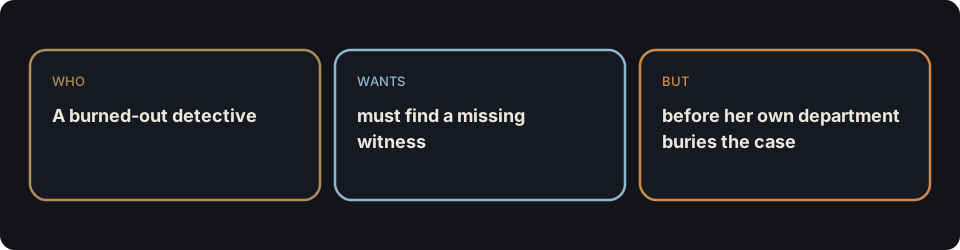
Who. Describe the protagonist by a trait that matters to the story, not by a name. "A recently widowed ferry pilot" gives the reader a person; "Anna" gives them nothing.
Wants. Say what the protagonist is trying to do. Often this starts with an inciting event, the thing that disturbs their life and forces a goal: a threat, an offer, a loss, a discovery.
But. Name the opposition and, if you can, what is at risk. This is the part writers skip most often, and it is the part that makes the story a story. Without an obstacle you have a situation, not a plot.
As a rule of thumb, a logline runs one sentence, or two at most, and roughly 25 to 50 words. That is a convention, not a law. A 60-word sentence that reads cleanly is better than a 30-word one that is cryptic.
Example loglines: weak and strong
The following examples are invented for this article. Each one shows a typical weak version and a rewrite.
Example 1: a thriller
Weak: "Sam is a detective who must solve a very dangerous case before it is too late."
Strong: "When a burned-out harbour detective discovers that the drowned man on his table was an informant he got killed, he has 48 hours to find the real culprit before his own captain buries the evidence."
What changed: the vague "very dangerous case" became a specific event, the protagonist got a defining trait and a personal stake, and an opposing force appeared.
Example 2: a family drama
Weak: "A story about forgiveness, family and the meaning of home."
Strong: "A retired baker who hasn't spoken to his daughter in ten years must sell the family shop to cover his medical bills, but the only buyer is the rival who ruined him."
What changed: a theme turned into a situation with a decision, a deadline and an antagonist.
Example 3: a comedy
Weak: "Two mismatched friends go on a hilarious road trip and learn a lot about themselves."
Strong: "A pedantic wedding planner and her chaotic sister have one weekend to drive a stolen cake across three counties before the bride, their mother, notices it is gone."
What changed: "mismatched" and "hilarious" were replaced by traits that can be seen on screen, and the trip got a goal and a clock.
Example 4: a sci-fi story
Weak: "In the future, a scientist, a soldier, a pilot, a hacker and an android must save the colony from an alien threat."
Strong: "After a power failure strands her on a mining colony, an exhausted systems engineer must keep two hundred sleeping settlers alive while the station's own AI quietly decides they are a waste of oxygen."
What changed: five characters became one, and a generic "alien threat" became an opponent with a clear logic.
Common logline mistakes
| Mistake | Why it hurts | Fix |
|---|---|---|
| Names instead of descriptions | The reader has no picture of the person | Use a role plus a defining trait |
| No obstacle or antagonist | There is no conflict, so no story | Add a "but" clause |
| Giving away the ending | A logline sells the setup, not the resolution | Stop at the central dilemma |
| Vague adjectives ("thrilling", "heartwarming") | They describe your opinion, not the story | Replace with a concrete event |
| Theme instead of story | "A film about love and loss" can describe anything | State what happens |
| Too many characters | The reader cannot hold more than one or two | Keep the protagonist and the main opposition |
A common related error is the "what if" question ("What if your best friend were your enemy?"). It can work in a verbal pitch, but in writing it dodges the commitment that a statement requires.
How to test your logline
Run through these checks before you send it anywhere.
- Can a stranger repeat it? Read it to someone outside the industry and ask them to retell it in their own words.
- Is there a visible conflict? You should be able to point to who opposes the protagonist.
- Does it have a decision or a clock? A choice, a deadline or a cost gives the story urgency.
- Does it avoid the ending? If a reader could guess the last scene, you have given too much.
- Does it match the script? A logline that promises something the pages do not deliver will damage trust fast.
If the logline is hard to write, that is useful information. It often means the central conflict in the screenplay is not yet clear, and the work to do is on the script, not the sentence.
Logline, beat sheet and coverage
The logline and the beat sheet describe the same story at opposite scales. The logline compresses it into one sentence; the beat sheet lays out the major turning points in order. A good habit is to write the logline first, then check that each major beat serves the "wants" and the "but". If a beat does not, either the beat or the logline is wrong.
Readers do the same thing in coverage: they compare what the logline promises with what the pages deliver. A script whose logline and content agree reads as focused. When they disagree, the reader usually notes it. STORYGRAPH's structure map makes it easier to see whether the story you built matches the one you described.
Takeaways
- A logline names a protagonist, a goal and an obstacle in one or two sentences, usually about 25 to 50 words.
- Describe people by what defines them in the story, not by their names.
- Without opposition there is no story; make sure the "but" is present.
- Sell the setup and the dilemma, never the ending or the theme alone.
- Test it on a stranger, and treat difficulty writing it as a signal about the script itself.