Script coverage is a short report, usually one to three pages, in which a professional reader summarises a screenplay and tells the person who commissioned it whether the script is worth their time. It contains a logline, a synopsis, written comments, grades against a handful of criteria and a verdict: Pass, Consider or Recommend. It is written for a decision-maker, not for the writer, which is the single most useful thing to remember when you read one.
What coverage is and who writes it
The word comes from the idea that a reader "covers" a script so that an executive does not have to read every page personally. Studios, production companies, talent agencies, literary managers, film funds and broadcasters all receive far more material than anyone can read. Readers (often called story analysts) filter it and write coverage on what survives.
Coverage also exists outside the gatekeeping system. Screenwriting competitions and paid feedback services produce reports in the same format, but addressed to the writer. These tend to be longer and more constructive, because the reader is not deciding whether the company should buy the script.
Practice differs between companies. Some want a half-page "short" for a first filter and a full report only for promising scripts. Others use a plain checklist. The structure below is the most common, not a universal standard.
Typical sections of a report
Most reports follow the same order, because the executive reads them in a hurry.
- Title page data: title, writer, format, page count, genre, setting, date, reader's name.
- Logline: one or two sentences stating protagonist, goal and obstacle. A weak logline in coverage often points at a weak premise; see how to write a logline.
- Synopsis: the story in roughly a page, present tense, with the ending included. It is a test of whether the plot can be summarised coherently at all.
- Comments: the reader's argument, normally three to six paragraphs on premise, structure, character, dialogue and marketability.
- Grades: a table with a rating for each criterion, commonly Excellent / Good / Fair / Poor.
- Verdict: Pass, Consider or Recommend, sometimes with a separate verdict for the writer ("Recommend writer, pass project").
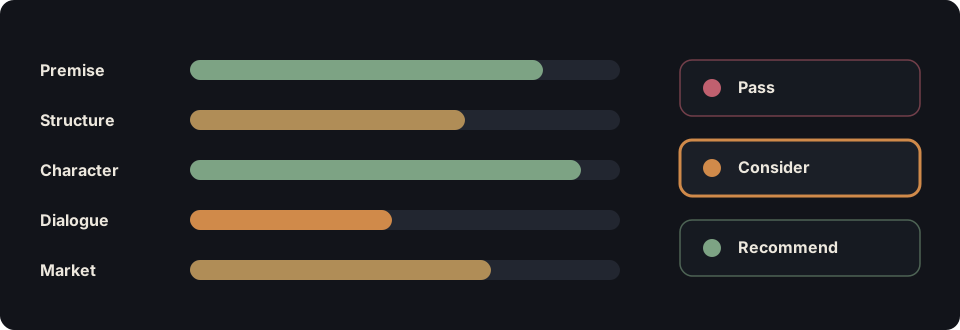
The three verdicts
Recommend means the reader believes the script should move forward, whether to purchase, option or a meeting. It is rare. Many readers give it only a handful of times a year, and a company that sees "Recommend" on every second script has stopped trusting its readers.
Consider means the script has real strengths but also problems that must be fixed or accepted. It is the most misunderstood grade. In practice it covers everything from "nearly there" to "interesting voice, wrong project". It is not a polite rejection, but it is not an invitation either.
Pass means that for this company, at this time, the script is not a fit. A Pass can reflect craft problems, but it can equally reflect a genre the company does not make, a budget it cannot carry or a project too close to something already in development.
How to read a Consider or a Pass
Start with the comments, not the verdict. A verdict is a summary of the argument, and the argument is where the value is.
Separate three kinds of statement. First, facts about the page: "the protagonist's goal changes at page 60", "three characters share the same speech pattern". These can be checked. Second, judgments: "the second act drags". These are probably true as a reaction, even when the diagnosis is wrong. Third, taste: "I did not warm to the narrator". Note it, but do not rewrite around one reader's taste.
Then look for repetition. If two independent readers use different words for the same problem, that problem is real. If only one reader raises something, test it against your own doubts. Writers usually already suspect where the weak scenes are.
Finally, do not argue with the report. A reader's confusion is data even when the reader misunderstood: it shows where the page allows a misreading.
Using coverage to rewrite
Turn the comments into a list of concrete changes, sorted from structural to local.
- Premise and structure first. If the report says the stakes are unclear or the middle stalls, fixing dialogue will not help. A stalled midsection is its own topic; see why the middle of a script sags.
- Character next. Check whether the protagonist wants something specific and whether choices, not events, drive scenes.
- Dialogue and style last. Polishing sentences before the structure is settled is wasted work.
Example of a comments paragraph
This is an invented example, not a real report.
Comments (excerpt). The premise, a night-shift paramedic who discovers her own address on a dispatch log for a call that has not yet happened, is strong and instantly pitchable. The first act delivers on it. From page 45, however, the protagonist stops pursuing the mystery and reacts to events: she is questioned, followed and warned, but makes few decisions. The antagonist, the dispatcher, is introduced as a threat but has no scene in which his motive is tested. Dialogue is economical and distinct for the leads; secondary characters speak in the same clipped register. The ending resolves the plot but not the protagonist's fear of the empty apartment, which the opening sets up as her wound.
How to use it: the repeated words are "stops pursuing" and "reacts". The to-do list is to give the protagonist an active goal in the second act, add a pivotal scene for the dispatcher, and pay off the apartment image. Voice differences for secondary characters are a final pass.
What coverage cannot tell you
- Whether the script will sell. Readers estimate fit, not market outcomes. Tastes, slates and budgets change.
- How the film will look. Coverage evaluates the page, not casting, direction or production design.
- The full truth of the writing. A one-to-three-page report cannot examine every scene. It captures the dominant impression.
- Anything about the budget or schedule. Those are separate analyses, done through a script breakdown.
A single report is one informed opinion, written quickly. Treat it as such.
How to get coverage
Paid services. Companies and freelance readers sell reports for a fixed fee, often with options for a short or detailed version. Look for readers with documented industry experience and ask for a sample report before paying.
Competitions. Many contests include written feedback, but quality varies, so check what is promised before you enter.
Trusted readers. Writers' groups and fellow screenwriters give honest feedback at no cost. Ask them to follow the coverage format and to summarise the plot back to you; if the synopsis is wrong, the script is unclear.
AI-assisted tools. Automated analysis can produce a logline, synopsis and structure notes quickly and can flag patterns such as missing turning points or uneven scene lengths. It does not have taste, industry context or the experience of reading a thousand scripts, so use it as an early pass before a human reader, not as a replacement. STORYGRAPH runs this kind of structural diagnostic on an imported script.
Whichever source you choose, send a script that is as good as you can make it. Coverage is most useful on a draft you believe in, because it shows you what you cannot see yourself.
Takeaways
- Coverage is a one-to-three-page report with logline, synopsis, comments, grades and a Pass / Consider / Recommend verdict.
- It is written for a decision-maker; the comments matter more than the verdict.
- Sort feedback into facts, judgments and taste, and act first on points that several readers repeat.
- Fix structure and character before dialogue and style.
- Coverage is one informed opinion, not a prediction of sales.