A second act sags when scenes stop raising the pressure on the protagonist: the want that started the story no longer drives events, obstacles repeat instead of escalating, and nothing changes from one scene to the next. The fix is rarely cosmetic. You restore a driving want, give each scene a conflict that leaves the hero worse or better placed than before, and put a real shift at the midpoint.
What a sagging middle looks like
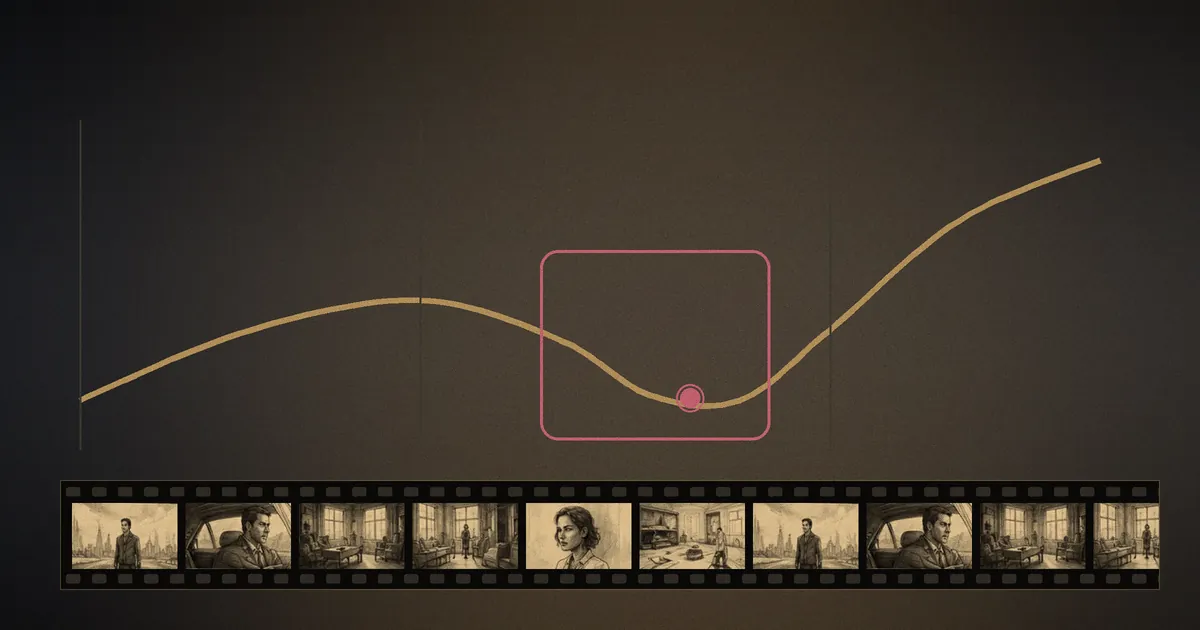
Roughly the middle half of a feature, from the end of Act One to the start of the final push, carries the longest stretch without a structural landmark. This is where the story has the most room to lose energy.
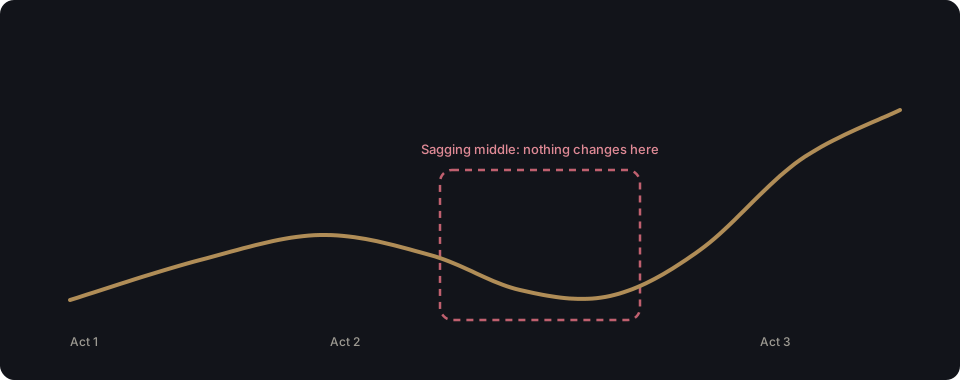
A reader's report, or coverage, typically flags the problem in recognisable language:
- "The story loses momentum after the first act break."
- "Scenes feel repetitive; the hero keeps having the same conversation."
- "The stakes are not clear in the middle section."
- "Subplots appear and vanish."
- "It is hard to say what the protagonist wants here."
If your own reader mentions pacing, "meandering" or "drift", look at the middle before the ending. For more on how readers assess scripts, see our guide to script coverage.
Why the middle sags: five common causes
1. The protagonist's want stops driving the scenes
Early scenes run on a clear want: get the money, win the case, reach the border. In the middle, the hero starts reacting to events and the want fades into the background. If you can remove the protagonist from a scene and it still plays, the want is not at work.
2. Obstacles repeat rather than escalate
A second obstacle that looks like the first (another door, another refusal, another chase) gives the audience nothing new. Obstacles should differ in kind or grow in cost. Moving from a closed door to a hostile witness to a betrayal by an ally is escalation; three closed doors are repetition.
3. A subplot stalls
A secondary storyline that does not advance for twenty pages is dead weight, even if it is charming. Each subplot should change state in the middle, ideally in a way that complicates the main plot.
4. Scene beats repeat
Two scenes can have different locations and the same shape: the hero asks, is refused, leaves. If the emotional or informational payload is identical, one of them can go.
5. No shift at the midpoint
Many structural models, including Blake Snyder's and several three-act paradigms, place a major reversal about halfway through. It does not have to be a famous "twist"; it can be a false victory, a revelation, or a change in the hero's goal. Without one, the second act becomes a single long ramp. See the beat sheet article for where this fits in the whole.
Not every film needs a midpoint turn, and some deliberately sustain a steady mood instead. But for plot-driven genres such as thrillers, comedies and dramas aimed at a wide audience, readers generally expect one.
A scene-by-scene diagnostic
Make a table with one row per scene in Act Two. For each, write the protagonist's goal in the scene, the obstacle, the outcome, and what has changed. Be strict: "they talk" is not an outcome.
Example only: three scenes from a heist drama, Act Two.
| Scene | Goal | Obstacle | Outcome | What changed |
|---|---|---|---|---|
| 31 | Get the vault blueprints | Clerk refuses | Hero bribes him | Hero is now in debt to a stranger |
| 32 | Get the blueprints approved | Partner distrusts the clerk | Partner agrees reluctantly | Nothing |
| 33 | Recruit the driver | Driver is in prison | Hero finds a lawyer | Nothing |
Scenes 32 and 33 have an outcome but no change. That pair is a candidate for combining or cutting. Run the same table across the whole act and count how many rows end with "nothing".
Then use this checklist:
- Can you state the hero's goal in every scene in one line?
- Does each scene end with a better or worse position for someone?
- Does the opposition act, or only react?
- Is the information in each scene new to the audience?
- Do the stakes increase at least every ten pages or so? (A rule of thumb, not a quota.)
- Is there a clear shift near the middle?
How to fix a sagging second act
- Raise the stakes. Add a cost, a deadline or a new person who could be hurt. Stakes work best when they are personal as well as external.
- Add a reversal at the midpoint. The hero gets what they wanted and it is wrong, or learns the real situation is worse, or loses the advantage. The goal after the midpoint should differ from the goal before it.
- Tighten the antagonist's plan. An opponent who is passive makes the middle slack. Ask what the antagonist does after each hero action, and make that move visible.
- Cut or combine scenes. Two scenes with the same payload can usually be merged into one stronger scene. Cutting a weak scene is often better than rewriting it.
- Link subplots to the main line. A subplot that interferes with the hero's plan earns its place.
- Add a ticking clock. A deadline compresses the middle without adding events.
After each fix, re-run the table. Improvements show up as fewer "nothing" rows.
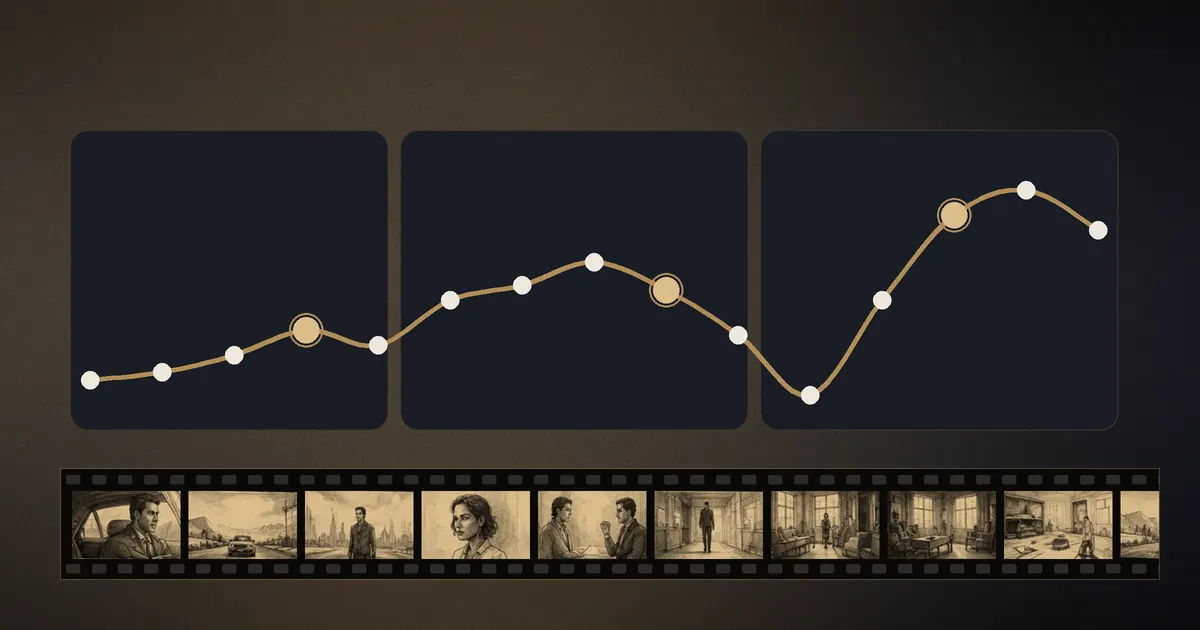
AI-assisted diagnostics, including STORYGRAPH's, can flag this pattern by showing scenes with low conflict or unchanged stakes, but a flag is a prompt for a second look. Whether a quiet scene is a weakness or a deliberate breather is a judgment only a human editor or the writer can make.
Takeaways
- A sagging middle is a symptom: the protagonist's want no longer drives scenes, or obstacles repeat instead of escalating.
- Typical reader notes: lost momentum, repetitive scenes, unclear stakes, vanished subplots.
- Diagnose scene by scene: goal, obstacle, outcome and what changed.
- Fix by raising stakes, adding a midpoint shift, sharpening the antagonist's plan and cutting or merging redundant scenes.
- Tools can point to suspect scenes; the final call is editorial.