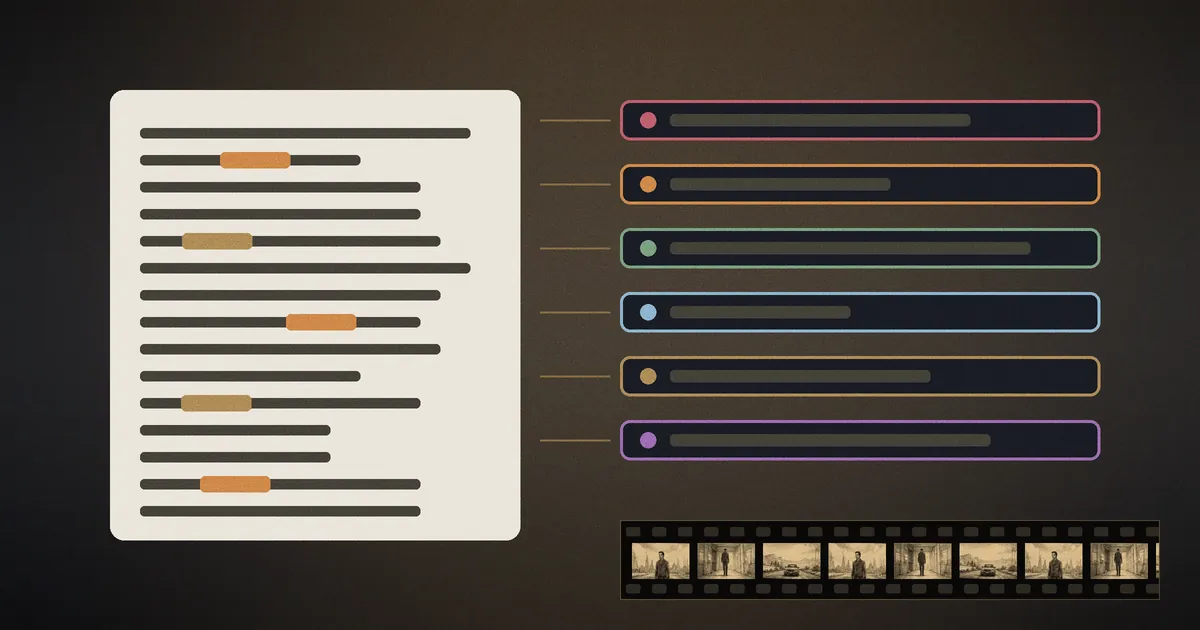
A script breakdown is the process of reading a screenplay scene by scene and tagging every element needed to shoot it: cast, extras, props, wardrobe, vehicles, effects and more. The result is a breakdown sheet for each scene, and those sheets are the raw material for the shooting schedule and the budget. This guide explains how a script breakdown works for beginners and what to watch for when you tag a screenplay.
What a breakdown is and why it comes first
A screenplay describes a story. A breakdown translates it into a list of things that must physically exist on set. Until that list exists, nobody can say honestly how long a film will take to shoot or how much it will cost.
The usual method is simple: read the script slowly, highlight or tag each element in a scene, then transfer the tagged items to a sheet. Producers, assistant directors and line producers all rely on it. Our overview of the pre-production workflow shows where the breakdown sits among the other steps.
Categories and colours
Breakdown categories are traditional and fairly consistent across productions. Typical ones include:
- Cast (speaking characters)
- Extras / background actors
- Stunts
- Vehicles
- Props
- Wardrobe
- Makeup and hair
- Special effects
- Visual effects
- Sound and music (playback, live music)
- Animals and animal handlers
- Set dressing
- Special equipment (cranes, drones, underwater housings)
Colour is how each category is marked on the page. A widely used convention, inherited from paper-and-highlighter days, gives each category its own colour, for example red for cast or green for extras. Treat that as one common convention, not a single official standard: software packages and production companies each use their own palettes, and what matters is that your team uses one scheme consistently.

Breakdown sheet fields
One sheet is made per scene. Fields vary slightly, but most include:
| Field | What goes in it |
|---|---|
| Scene number | As in the locked script |
| INT / EXT | Interior or exterior |
| Set / location | The scripted set, for example "Marta's kitchen" |
| Day / night | Time of day as written (plus dawn or dusk if needed) |
| Page count | Length in eighths of a page |
| Description | One line of what happens |
| Cast IDs | Numbers assigned to each speaking character |
| Elements | Everything from the categories above |
Cast ID numbers are assigned once, usually in order of first appearance or importance, and used everywhere afterwards. They keep sheets short and the schedule readable.
Counting page length in eighths
Page length is counted in eighths of a page because a page of properly formatted screenplay is about eight units tall. A scene occupying the whole page is 1; a scene that is about half a page long is 4/8; one and a quarter pages is written 1 2/8.
To count, measure each scene against the page. Many people use an eighths ruler; software does it automatically. Round up when in doubt, since the number is a tool for scheduling and exact precision is less important than consistency. It is a rule of thumb that one page of script is roughly a minute of screen time, but action-heavy and dialogue-heavy pages can differ a lot.
Worked example
This scene is invented for illustration.
12. INT. MARTA'S KITCHEN - NIGHT Marta, 40s, fries fish at the stove. Her brother DAN, soaked and with a bleeding hand, bursts in. A car door slams outside. Their dog barks. Marta hides a kitchen knife in her apron.
Breakdown sheet:
| Field | Entry |
|---|---|
| Scene | 12 |
| INT/EXT | INT |
| Set | Marta's kitchen |
| Day/Night | Night |
| Pages | 1 3/8 |
| Description | Dan arrives hurt; Marta hides a knife |
| Cast | 1 Marta, 2 Dan |
| Extras | None |
| Props | Frying pan, fish, kitchen knife, kitchen towel |
| Wardrobe | Marta: apron. Dan: soaked clothes (wet-down continuity) |
| Makeup | Dan: bleeding hand |
| Vehicles | Car (off-screen, sound only) |
| Animals | Dog (barking, off-screen) |
| Sound | Car door slam, dog bark |
| Special effects | Rain or wet-down, blood on hand, gas stove with flame |
| Set dressing | Stove, sink, pantry items |
Notice the items that are not written in the scene but are required: the towel, the wet-down and the stove flame are implied. Experienced breakdown people catch these.
How the breakdown feeds schedule and budget
Each sheet is transferred to a strip on a stripboard, a scheduling board where strips are ordered into shooting days. The strips group scenes by location, day or night, and cast availability, so that you do not move the crew more than needed. Cast IDs then produce a day-out-of-days chart showing which actor is needed on which day; see our guide to the day out of days.
For the budget, the totals of each category become line items: how many days of the dog handler, how many wardrobe changes, how many vehicles, what special effects. The breakdown is the reason a budget can be tied to specific scenes rather than guessed from page count.
Common mistakes
- Missing implied props. If a character drinks coffee, there is a cup and coffee, even if the script does not say so.
- Overlooking day/night and continuity. A wet jacket in scene 12 must still be wet in scene 13 if they follow directly.
- Forgetting extras, stunts and animals. A "crowded station" needs background actors; a punch may need a stunt coordinator; a dog needs a handler and has working-hour limits.
- Not flagging safety-sensitive items. Weapons, fire, water, heights, minors and vehicles in motion should be marked clearly so that safety planning and insurance can account for them.
- Breaking down an unlocked draft without a note. If scenes are renumbered later, the sheets must be updated; keep track of script revisions.
STORYGRAPH produces a first-pass breakdown from the imported screenplay automatically, which you can then correct by hand.
Takeaways
- A breakdown turns a story into a list of physical requirements, scene by scene.
- Use a consistent colour and category scheme; there is no single official palette.
- Record page length in eighths, with a sheet per scene and numbered cast IDs.
- The sheets feed the stripboard, the day-out-of-days and the budget.
- Most errors come from what the script implies but does not state: props, continuity, extras, animals and safety.